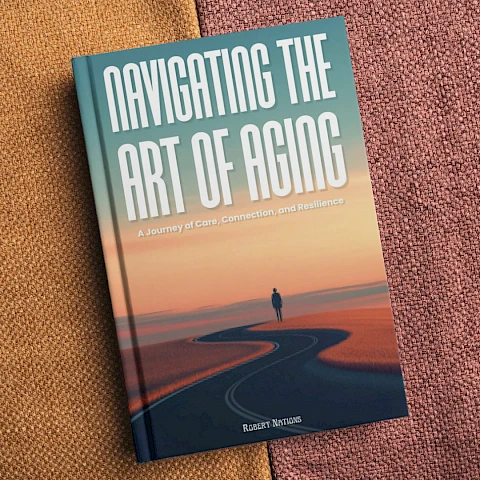
Episode Transcript:
Christina Chartrand:
Hi, and welcome to LIFE Conversations. I am Christina Chartrand.
David Chandler:
I'm David Chandler.
Christina Chartrand:
And we are so excited to have you here today. We’re talking with my friend, Bob Nations, about his brand-new book Navigating the Art of Aging.
Bob Nations:
Ha!
Christina Chartrand:
We’re so glad to have you and to talk about this wonderful book. I keep thinking of more and more people that I want to read it. It’s a fantastic timeline of your years with Senior Helpers, sharing so many wonderful stories about your clients and the ways you’ve impacted people in your community. I’ve truly enjoyed it and love sharing it with others.
Today, we’re excited to allow our listeners to learn a little more about this book and some of your personal experiences, Bob. They come from the heart and offer some really good lessons to learn.
David Chandler:
When I think about this book, having come from a background in medical care, we used to say, “We should write a book about all these crazy stories.” There are so many amazing, sad, and even scary things that happen. We’d talk about them all the time—how wild and human this work can be. Well, you actually did it!
Bob, how long have you been with Senior Helpers now?
Bob Nations:
Just over 17 years.
David Chandler:
Seventeen years—and an amazing career before that in the toy industry, right?
Bob Nations:
Right, thirty years in the toy industry.
David Chandler:
So, taking all of that experience and these incredible stories—you and I were talking before this recording about how these stories just stay with you. You don’t forget them. Bob, can you share a little bit about yourself, and then we’ll start diving into the book?
Bob Nations:
Sure. The idea for the book came from the fact that I entered this industry with no knowledge of home care. I dove right in and tried to absorb as much as I could. I really did learn on the job. Over time, I’d tell these stories, and people would always say, “Bob, these are great. You should write a book!” I’d laugh and say, “No one’s going to want to read something I wrote.”
But eventually, I realized that these stories could help people—those caring for loved ones or those navigating aging themselves. That’s what led me to write Navigating the Art of Aging—to share my journey in hopes of helping others on theirs.
Christina Chartrand:
I’ve enjoyed so many of the different stories you wrote, Bob. That’s one of the things I love about the book—the way it’s set up. You can read one story, put it down, and then easily pick it up again later. Each story stands on its own and has its own little takeaway.
Bob Nations:
Thank you.
Christina Chartrand:
For me, if I had just a minute or two, I’d read a chapter, then go back to work, and later I’d read another one. Every time, I’d think, “Oh my gosh, this is amazing.”
For our listeners, David and I both work for a company called Senior Helpers—it’s a home care business with offices all across the country. Bob Nations owns the Senior Helpers franchise in the Napa Valley area, which, of course, is one of my favorite places ever.
All these stories come from his experience growing that business and developing relationships with clients. I also have to say, Bob is one of our top performers. Among all the offices across the country, his does incredibly well.
Bob Nations:
Yeah.
Christina Chartrand:
And when you think about that—someone who owns a successful business—it’s easy to imagine they’re just focused on the “big business” side of things. But after reading this book, you realize that’s not the case at all.
The relationships you’ve built and the connections you’ve made are what truly make you successful. It’s the relationships with your community, your caregivers, and your clients that have really set you apart.
That’s what I keep telling people when I share this book: you can’t just step away and let things run like a machine. We’re in the people business, and you’ve really shown us what it means to be in the business of helping others.
Bob Nations:
That’s such a key point because I tell people all the time—it’s really about the people. If you make it about the people, the business part becomes easy. You create a positive, rewarding atmosphere, and that energy carries you. It makes it easy to run a business because it’s so fulfilling.
David Chandler:
Bob, one of the things I’ve heard you talk about before is the name Senior Helpers. What does that mean to you?
Bob Nations:
That’s actually one of the reasons I bought into the franchise—I loved the name. It perfectly described who we are.
From the beginning, I made it our mission to help everyone who calls, no matter what they need. If we can’t help them ourselves, we’ll find someone who can. That’s what “helpers” means to me.
One of the very first calls I got was from a social worker who said, “This lady needs help moving. Can you help her move?” It had nothing to do with caregiving, but I said, “Of course.”
I vetted a moving company, personally introduced them to the client—just like we do with our caregivers—and helped her through the process. I didn’t physically move her, but I made sure she had the help she needed. That was one of my first calls when I started out, and I’ve kept that philosophy ever since.
Christina Chartrand:
I love that. Why don’t you share one of your stories—maybe one of your favorites—for our listeners?
David Chandler:
Yes, please!
Bob Nations:
Sure. One of the first stories in the book is about a man I call Dr. J. I made the names generic so no one would know who the real people were.
Dr. J came to me just before Mother’s Day during my first year. He was a retired anesthesiologist, about 90 years old. His daughter called and said, “Our dad needs help at home.”
So, we started caring for him. I remember Mother’s Day so clearly because I didn’t have a caregiver available, and I had to tell my wife, “I’m sorry, I need to go take care of him.” So, I spent the night sitting with him in his recliner.
Through the night, he kept waking me up to help him to the bathroom, even though he didn’t really need the help. I think that’s part of why the family called—he was high-maintenance and very ego-driven. He had been chief anesthesiologist at a hospital, and he carried that pride with him.
But that night, we bonded. I started getting more involved in his life, to the point that his children stopped being involved. I became what I call his surrogate son and helped manage his world.
He was a multimillionaire—owned acres of vineyards—but he had alienated his kids. They wanted nothing to do with him. So I stepped in to help.
At first, he’d call me saying things like, “Hey, just bring a shotgun, I want to end it all.” Of course, I never would, but I’d go sit with him and talk through what was really going on. Eventually, I realized the problem—he had no life anymore. He wasn’t playing golf, seeing patients, or doing anything he enjoyed.
So, I decided to engage him again in life. I learned he loved going out to dinner. So, I started taking him out.
The upside? He had very high-end taste, so I got to visit some of the finest restaurants in town! Later, I learned that his late wife had been a physician and had a medical assistant who was around his age. They had been close, so I started bringing her along too. The three of us would go to dinner, and he loved it.
That changed everything. His quality of life improved, and those calls asking me to “end it all” stopped.
So those dinners really gave him something to look forward to. His outlook changed, and he became so much more engaged. But eventually, his health began to decline.
Toward the end of his life, he developed a blocked bladder. I took him to the ER, and the doctor told us that if he didn’t have surgery, he wouldn’t live much longer. At first, he said he wanted the surgery.
Later that day, though, I got a call from the surgeon saying, “He’s refusing the operation.” I rushed to the hospital and asked him what was going on. He said, “You know, I’ve decided I’ve done enough in my life. I don’t want to go through this.”
So I said, “Okay.” I looked at the surgeon and told him, “I’m sorry you prepped everything, but we’re taking him home and putting him on hospice.”
Now, keep in mind—this man had five adult children—but I was the one by his side through the entire process. I got him home, arranged hospice care, and within a week he passed away.
It was powerful. He trusted me completely and allowed me to be part of such an intimate chapter of his life. Even after his passing, his family included me in the memorial planning, treating me like one of their own. It was deeply humbling and something I’ll never forget.
David Chandler:
Wow. When I hear that story, I was expecting a different ending—I thought you were going to say you convinced him to go through with the surgery. But instead, you respected his wishes. You cared about him enough to give him that choice, to stand by him, and to help him pass on his own terms. That says so much about who you are and what caregiving really means.
Bob Nations:
Thank you, David. That story actually leads perfectly into another one from the book—it’s almost the opposite situation.
This next story is about a man who moved to Napa with his mother. From what I gathered, he had never married and had no real relationships outside his family. He and his mother moved here to be closer to his sister, but shortly after they arrived, his sister passed away. Then his mother passed away not long after that.
He was suddenly alone—no friends, no church, no community. The way he found me was through a Senior Helpers advertisement. He called and said, “My doctor took away my driver’s license. I have no way to get around.”
So I went to see him, and we put together a plan. For weeks, he’d call me to take him grocery shopping or to the barber. Over time, his needs grew, but I knew money would be a challenge—he didn’t have much. Then I learned that he was a Navy veteran, which opened the door to the Veterans Administration’s Aid and Attendance program.
I worked with him to complete all the paperwork and took it to our local Veteran Service Officer, who helped us submit it. Back then, it could take up to a year for approval. Today it’s much faster—just 30 to 60 days—but back then we had to wait.
About a year later, he called me sounding panicked and said, “You’ve got to come over here right now.” So I went. When I got there, he looked at me with tears in his eyes and handed me a letter. It was from the VA—a check for $30,000 in retroactive benefits.
He had never seen that kind of money in his life. He was ecstatic and said he could never have done it without my help. We celebrated together that day.
As time went on, his care needs increased. I’ll never forget one Christmas—I was planning to visit my family in Texas but was worried about leaving him alone. So I arranged for him to stay at an assisted living community for a week.
I told him it was like a resort vacation. He was nervous at first, thinking I was trying to move him there permanently, but I promised it was only temporary. Once I got back from my trip, we returned him home.
Later, he and I went to a doctor’s appointment, and that’s when we got the bad news—he had cancer, and there was nothing they could do. The doctor said it was terminal.
We sat together and decided that hospice would be the best path forward. He told me the only thing he wanted was to die next to his piano. He had been an art and music teacher, and in his tiny living room sat a baby grand piano. That’s where he wanted to be.
When hospice came to set up his hospital bed, I made sure it was placed right beside that piano.
One day, I went to visit and found him asleep. He looked so pale and still that I thought he had passed away. I sat by him, held his hand, and started crying. Then he opened his eyes and said, “Why are you crying?”
I told him, “Because I’m sad that you’re going to be leaving me.”
He said, “Well, I’m not leaving yet. And I can’t believe no one’s ever cried for me before.”
Of course, that made me cry even harder. We just sat there, holding hands.
Eventually, he passed away peacefully—right there next to his piano. I’ll never forget that moment.
And you know, it wasn’t all sad. He had these moments of joy. For example, the first time he ever went to In-N-Out Burger was with me. Watching his face light up while eating that cheeseburger was unforgettable.
Christina Chartrand:
They’re the best! I just have to say that—In-N-Out is amazing.
Bob Nations:
Right? He loved it.