


How to Talk to a Parent About Accepting Help at Home
Skip main navigation
Type Size
Past main navigation Contact Us
How to Talk to a Parent About Accepting Help at Home

How to Talk to a Parent About Accepting Help at Home

For many families, it's one of the most emotionally charged conversations they'll ever have — and one of the most important.

Maybe you've noticed your mom struggling to keep up with the house. Maybe your dad had a close call that scared everyone. Or maybe nothing dramatic happened at all — you just sense that things are changing, and you're worried.

You want to help. But every time you bring it up, it doesn't go well.

You're not alone. Millions of adult children navigate this exact conversation every year, and it's rarely easy. Understanding why it's so hard — and knowing what actually helps — can make all the difference.
Why Aging Adults Often Resist Help at Home

Before you can have a productive conversation, it helps to understand what's really going on beneath the surface.

When a parent refuses help, it usually isn't about stubbornness for its own sake. It's about something much deeper:

Fear of losing independence. For most people, the ability to manage their own home and daily life is deeply tied to their sense of identity and self-worth. Accepting help can feel like the beginning of the end of that independence.

Fear of what it means. Needing help at home can feel like an admission that things are getting worse — and many seniors aren't ready to face that yet.

Privacy and dignity. The idea of a stranger in their home, helping with personal tasks, can feel deeply uncomfortable or even humiliating.

Past experiences. If your parent has seen a friend or sibling move to a facility after accepting help, they may fear that in-home care is just the first step toward losing their home entirely.

Understanding this doesn't mean you stop advocating for their safety. It means you approach the conversation with empathy instead of urgency — which tends to work a lot better.

When to Have the Conversation (and When to Wait)

Timing matters. A few guidelines:

Don't wait for a crisis. The best time to have this conversation is before something goes wrong — not in the aftermath of a fall, a hospitalization, or a serious incident. Crisis moments are emotionally charged for everyone, and decisions made under stress are rarely the best ones.

Choose a calm, private moment. Avoid bringing this up at family gatherings, holidays, or other high-stress occasions. A quiet one-on-one conversation at home tends to work better than an "intervention" style discussion with multiple family members.

Give it more than one conversation. This is rarely a topic that gets resolved in a single sitting. Plant the seed, let it breathe, and come back to it. Pressure usually backfires.

Words That Open the Door, and Words That Close It

How you say something matters as much as what you say. Here are some practical language shifts that can change the tone of the conversation:

Instead of: "You need help."

Try: "I'd feel so much better knowing someone was here with you sometimes."

Framing it around your own feelings — rather than their limitations — takes the defensiveness out of the conversation. You're not telling them what they can't do. You're sharing how much you care.

Instead of: "I'm worried about you living alone."

Try: "What would make you feel safest and most comfortable at home?"

Asking questions instead of making declarations gives your parent a voice in the conversation. It shifts the dynamic from something being done to them to something being figured out together.

Instead of: "You can't keep doing this on your own."

Try: "What parts of things feel the most manageable? What feels harder?"

This opens the door without forcing it. You may be surprised — many seniors are more aware of their challenges than they let on. They just need to feel safe saying so.

How to Involve Your Parent in the Decision

One of the most effective things you can do is make your parent a partner in the process — not a passenger.

This might look like:

  • Asking them to help define what kind of help they'd actually want, on their own terms
  • Letting them meet the potential care provider and be a part of the assessment process before any decisions are made
  • Starting small — a few hours a week for companionship or light tasks — so it doesn't feel overwhelming
  • Making clear that accepting help doesn't mean giving up their home or their independence

The goal is to give them a sense of agency. When people feel like something is happening to them, they resist. When they feel like they're making a choice, they're far more likely to engage.

What to Do When They Still Say No

Sometimes, even the most thoughtful conversation doesn't result in a yes. Here's how to move forward:

Respect the "not yet." If your parent isn't in immediate danger, a temporary no doesn't have to be a permanent one. Revisit the conversation after some time has passed.

Find an ally. Sometimes a parent is more receptive to hearing something from their doctor, a trusted friend, or another family member than from a child. If there's someone in your parent's life who could support the conversation, consider involving them.

Document your concerns. If safety is a genuine issue, keeping a written record of incidents or close calls can help you — and potentially a physician — make a stronger case.

Know when to escalate. If your parent's health or safety is at immediate risk and they are cognitively impaired, you may need to involve medical professionals or consult with an elder law attorney about next steps.

A Final Note: This Is Hard for a Reason

If these conversations feel painful, that's not a sign you're doing it wrong. It's a sign that you love your parent and they value their independence — two things that are both deeply human.

Give yourself grace. Give your parent grace. And know that even an imperfect conversation is better than silence.

If you'd like guidance specific to your family's situation, the team at Senior Helpers is here to help. We've walked alongside thousands of families through exactly this transition, and we're happy to talk through your options — no pressure, no commitment.

Find a Senior Helpers location near you →

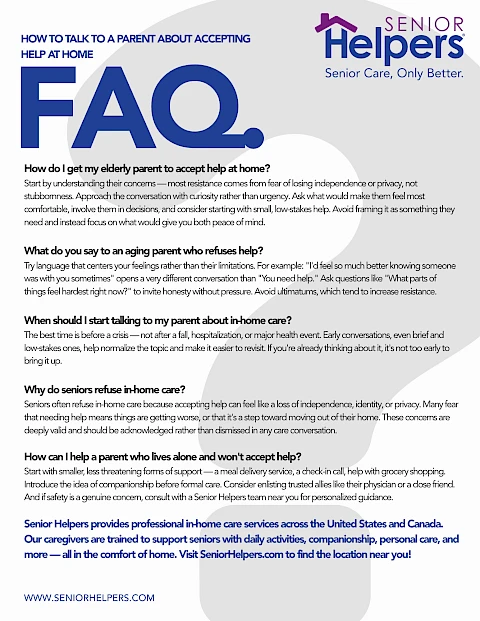
Download a copy of our FAQs here!