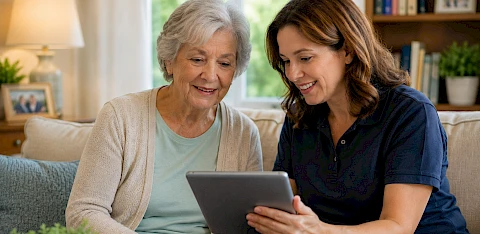
I recently spoke at the Health 2.0 conference on the topic of technology in eldercare and, at its core, this conversation is about artificial intelligence and how it will—if used wisely—reshape the way care is actually delivered in the home.
Artificial intelligence is making its way into non-medical home care, bringing both opportunity and unease. For families trying to support an aging parent—and for agencies responsible for delivering reliable, high-quality care—the conversation has shifted. It’s no longer about whether AI will be part of the future, but how thoughtfully it will be introduced and whether it will enhance—or quietly erode—what matters most: the human experience of being cared for.
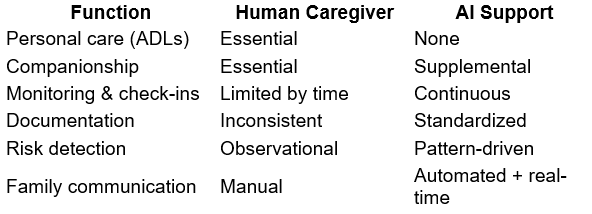
There is a tendency to frame AI as a replacement for caregivers—devices in the home, robots, and automation stepping in for people. That framing is not just simplistic—it’s wrong. The more likely, and more effective, path forward is a blended model, where technology supports care rather than substitutes for it.
Still, before any of that can take hold, there is a very real hurdle to overcome. Many older adults—and often their families—are wary of AI. To them, it can feel impersonal, intrusive, even unsettling. Questions surface quickly: Who is listening? What’s being tracked? Am I losing control?
These concerns are not abstract. They come from a generation that has spent a lifetime protecting its independence and privacy. If AI is introduced without sensitivity to those concerns, it will be resisted—if not outright rejected.
The difference lies in how the technology is positioned and used. When it is framed as a tool that helps someone remain independent longer—or reduces the burden on a spouse or adult child—the reaction shifts. It becomes less about surveillance and more about support. Less about being watched, and more about having someone—or something—quietly looking out for you.
From an operational standpoint, agencies don’t have much of a choice. The pressures on the current home care model are undeniable. Caregiver shortages persist, costs continue to rise, and families expect more visibility, responsiveness, and consistency.
Care is often delivered in fragments—five hours a day, six days a week, sometimes with multiple caregivers rotating through the same home. In real life, that means handoffs, missed nuances, and small but meaningful details getting lost between shifts. Communication gaps are not the exception; they are the norm. This is where thoughtfully applied technology begins to show its value.
But technology, on its own, is not a strategy. The real question is: how does it fit into a broader plan for aging well?
That is where frameworks matter.
Through the Aging Advantage Guide, we’ve long emphasized that successful aging is not reactive—it is planned. And at the center of that planning is a clear understanding of two things: what matters most to the individual, and what they actually need as their condition evolves.
The Age-Friendly Care “4Ms” framework—What Matters, Mentation, Mobility, and Medication—helps define a person’s priorities. It captures preferences, goals, and quality-of-life considerations. In other words, it defines the wants.
The Life Profile framework complements that by defining the needs across five critical dimensions: safety, medical condition (including medication and vital management), autonomy in daily activities, burden of care, and life engagement.
Real success lies in balancing the two.
This is where AI, used properly, becomes powerful—not as a replacement for care, but as a tool to help maintain that balance over time.
Two practical examples illustrate this.
First, conversational check-ins between caregiver visits. These are not rigid scripts, but natural interactions designed to gauge how someone is doing on a given day. Over time, they can detect subtle changes in routine, mood, or cognition—small shifts that might otherwise go unnoticed. When aligned with a Life Profile, these check-ins are not random—they are purposeful, tied to known risks in safety, cognition, or engagement.
Second, communication and information flow. Anyone involved in caring for an older adult understands how fragmented information can become. One family member hears one thing, a caregiver notes another, and the agency may only see part of the picture. When multiple caregivers—both professional and family—are involved, important details inevitably slip through the cracks.
With the right systems in place, information can be captured more consistently and shared more effectively. Patterns begin to emerge. Subtle changes become visible earlier. And when those insights are mapped back to both “What Matters” and the Life Profile, decisions become clearer, more proactive, and better aligned with the individual’s goals.
At the center of this shift is a model that blends human care and technology—each doing what it does best.
Intelligently Blended Care Model