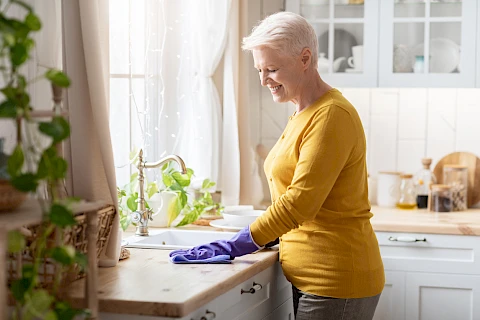
The kitchen is the room most people spend the most time in and think about the least, safety-wise. September is Food Safety Education Month, and while a lot of the attention this month goes to fridge temperatures and expiration dates, creating safer kitchens for older adults often comes down to addressing bigger daily risks like burns, cuts, and reaching for something on a high shelf. A few simple changes can head off a bad afternoon.
Start With How the Kitchen Is Laid Out
Look at where daily-use items live right now. Coffee mugs on the top shelf. A heavy Dutch oven under the counter. Any one of those is a common fall or strain injury waiting for a bad Tuesday.
Move the things you touch every day into the zone between hip and shoulder height. Heavy items go low.
Get rid of the wobbly stepstool. If a step is truly necessary, replace it with a sturdy two-step stool with a handle.
Prevent the Burns That Actually Happen
According to the American Burn Association, older adults have some of the highest rates of scald and cooking-fire injuries at home.
Turn pot handles inward, toward the back of the stove. Wear short sleeves or roll them up when cooking. Use dry oven mitts, never a wet dishcloth. Keep a lid within arm's reach when you're frying; smothering a grease fire is faster and safer than moving a burning pan.
Don't lean over a boiling pot to smell it. If eyesight has been changing, mark the stove-off position on each burner knob with a raised sticker or a dab of nail polish so it's easy to feel.
Appliances, Old and New
Older appliances suit a familiar routine, but a few upgrades earn their keep. An electric kettle with automatic shut-off is safer than a whistling kettle for anyone who sometimes forgets it's on. A slow cooker or countertop oven can take the pressure off a big burner.
Check the microwave. If the door doesn't seal properly or the turntable wobbles, replace it. Same for the toaster: a frayed cord or a stuck lever is a fire risk, not a quirk.
Install a smoke alarm in the kitchen if there isn't one within earshot, and test it monthly. Consider a stovetop fire suppressor that mounts under a range hood. It costs less than dinner for four in Chagrin Falls.
Sharp Tools, Slippery Floors, and Good Light
A dull knife is more dangerous than a sharp one because it slips. Keep a small stone in the drawer, or take knives to be sharpened twice a year. Cut on a stable cutting board with a wet paper towel underneath to keep it from sliding.
Wipe spills right away. Water on a tile floor in Hudson or Kent is a fall waiting to happen. Non-slip rugs at the sink work if they actually don't slip. Test yours by kicking it. If it moves, replace it.
Good light is safety equipment. Under-cabinet strips over the countertop and a bright overhead light over the stove make chopping and pouring much safer than they sound.
Comfortable, Safer Kitchens Across Portage and Geauga Counties
Senior Helpers of Portage/Geauga works with families in Aurora, Chagrin Falls, Chesterland, Hudson, Kent, and Ravenna on the practical parts of home life, including safer kitchens, meal prep, and a steady set of eyes on the details. If you'd like a caregiver to walk through the kitchen with your parents and make a short list of changes, contact us, and we'll set it up.