It often starts with the television. The volume creeps up little by little until family members are wincing in the next room. Or conversations at dinner become an exercise in strategic nodding, with your loved one following the mood of the room rather than the actual words. Hearing loss in older adults tends to arrive gradually, which is exactly what makes it easy to overlook until it has a real effect on daily life.
How Hearing Changes With Age
Age-related hearing loss, known as presbycusis, is one of the most common conditions among older adults. It develops as the tiny hair cells inside the cochlea wear down over time. Those cells don't regenerate, so the changes are cumulative and permanent, though they're often very manageable with the right support.
The loss tends to affect high-frequency sounds first. Consonant sounds like "s," "f," and "th" become harder to distinguish, which is why speech can sound muffled even when it seems loud enough. Background noise compounds the problem significantly. A senior who follows a one-on-one conversation at home may genuinely struggle to keep up in a crowded restaurant or at a family gathering.
The National Institute on Deafness and Other Communication Disorders reports that about one in three adults between 65 and 74 has hearing loss. That proportion rises to nearly half among adults 75 and older.
Quality of Life and Safety
Beyond the television volume, watch for your loved one frequently asking people to repeat themselves, struggling on phone calls, or misunderstanding words in ways that feel new. Social withdrawal can be a quieter signal: some seniors pull back from conversations and group settings because following along has become exhausting, not because they've lost interest.
There's also a safety dimension. Being unable to hear a smoke alarm, a car horn, or a warning called out from across the street is a significant risk that tends to receive less attention than it deserves. Families who notice these patterns should treat them as reasons to schedule an evaluation, not to wait and see.
Taking a Hearing Evaluation
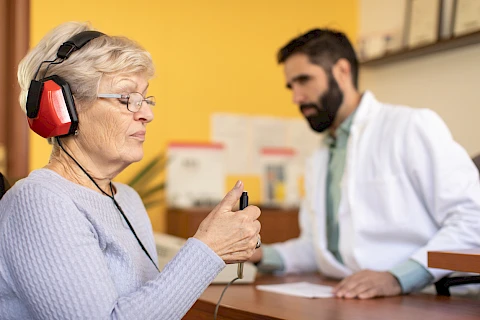
An audiologist will typically conduct a series of tone and speech tests in a soundproofed room. The results produce an audiogram that maps the pattern and degree of hearing loss across different frequencies. The appointment is painless, takes under an hour, and often provides clarity that both the senior and their family find genuinely reassuring.
The American Academy of Audiology recommends that adults over 60 have a baseline hearing evaluation, even without noticeable symptoms, because early detection offers more options. Hearing aid technology has improved substantially. Many current devices are small, rechargeable, and capable of reducing background noise more effectively than older models.
Asking the Right Questions
During the appointment, ask whether the identified type of hearing loss is likely to progress, which assistive devices or technologies are appropriate, and whether any underlying medical issues should be ruled out. Some hearing loss is related to earwax buildup, infections, or medications, all of which can be addressed with different interventions.
Staying Connected With Support From Senior Helpers
Hearing well is part of staying socially connected, safe, and fully engaged in daily life. Senior Helpers Grand Rapids serves families across Cascade, Byron Center, Forest Hills, Grandville, and Northview. If your loved one could use support at home as they navigate health changes, contact us to learn more about our in-home care services.