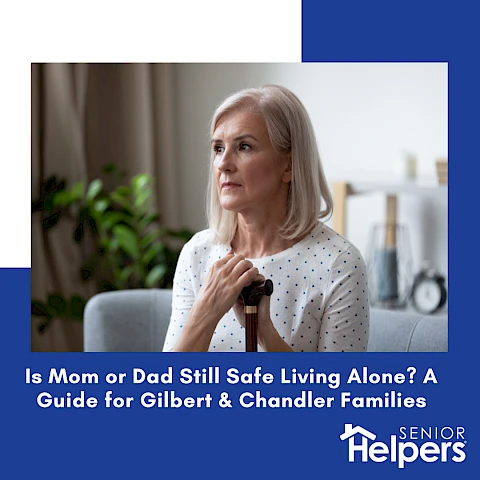
Is Mom or Dad Still Safe Living Alone? A Guide for Gilbert & Chandler Families
Mom says she’s fine.
And honestly, in many ways, she is.
She still makes her own breakfast. She remembers when the grandkids are coming over. She enjoys her morning coffee in the same chair she has sat in for years. And if you ask whether she needs help?
The answer comes quickly.
“I’m fine. I don’t need anyone taking care of me.”
But lately, you’ve noticed little things.
There are fewer groceries in the refrigerator. A medication was missed. Dad seems a little less steady getting up from his chair. Mom stopped going to an activity she used to enjoy. The house isn’t quite as tidy as it once was.
Nothing feels like an emergency.
But something feels different.
For many families in Gilbert and Chandler, this is when a difficult question starts creeping in:
Is my parent still safe living alone?
The answer isn’t always yes or no. And needing some support at home doesn’t necessarily mean a parent has to give up their independence.
Sometimes, the right amount of help can actually help preserve it.
Look for Changes, Not Just a Crisis
Families often assume there will be one obvious moment when it becomes clear that Mom or Dad needs help.
Sometimes there is a fall, hospitalization or sudden health change can make the need obvious.
But often, changes happen gradually.
When you visit your parent regularly, those small changes can be easy to miss. Instead of looking for one big warning sign, pay attention to patterns that are different from what is normal for your loved one.
Here are some areas worth noticing.
1. Changes Around the Home
Take a look around the next time you visit.
Are dishes or laundry piling up when they normally wouldn't?
Is expired food accumulating in the refrigerator?
Are there unopened bills or stacks of mail?
Has basic home upkeep become harder?
One messy afternoon doesn't necessarily mean anything is wrong. What matters is whether you're seeing a change from your parent's usual habits.
2. Changes in Mobility
Maybe Dad is still walking around the house independently, but you've noticed him reaching for furniture.
Maybe Mom has started avoiding the stairs.
Perhaps there have been unexplained bruises, a near-fall or a fall she didn't mention until later.
Changes in mobility deserve attention because they can affect so many other parts of daily life from bathing and getting dressed to preparing meals and leaving the house.
3. Changes in Meals and Nutrition
One of the first places adult children sometimes notice a difference is the kitchen.
Is Mom eating regular meals?
Does Dad still have fresh food available?
Have groceries become more difficult to manage?
Are meals becoming simpler because cooking feels like too much work?
If you live nearby, look inside the refrigerator rather than simply asking, “Are you eating?”
The answer may tell you more than the question.
4. Changes in Personal Care
Pay attention to changes in grooming, clothing or hygiene, particularly when these things have always mattered to your parents.
The issue isn't about appearance.
A change may indicate that bathing, dressing, laundry or another everyday activity has become more physically or mentally challenging.
5. Changes in Medication Routines
Medication management can become more complicated over time, particularly when someone has several prescriptions or dosing schedules.
You might notice missed doses, duplicate doses, confusion around refill dates or medications that aren't being taken as expected.
This is an area where changes should be taken seriously and discussed with the appropriate healthcare professional.
6. Changes in Memory or Thinking
Everyone forgets things occasionally.
What you're looking for is a noticeable change from your parent's normal behavior.
Are they repeatedly asking the same question?
Missing appointments they would normally remember?
Becoming confused about familiar routines?
Having more difficulty following conversations or completing everyday tasks?
If you notice new or concerning cognitive changes, discussing them with your parent's healthcare provider is an important next step.
7. Changes in Social Connection
Safety isn't only about preventing falls.
Quality of life matters, too.
Has your parent stopped attending church, meeting friends, participating in hobbies or doing things they once enjoyed?
Are they spending most days alone?
Sometimes a parent can technically manage the tasks of living alone while becoming increasingly isolated.
That deserves attention too.
A Better Question Than “Can Mom Live Alone?”
“Can Mom still live alone?” can feel like an all-or-nothing question.
Try asking something different:
“What would help Mom continue living at home safely and independently?”
That changes the conversation.
Maybe she doesn't need someone with her every day.
Perhaps she needs help getting to appointments.
Maybe preparing meals has become difficult.
Maybe Dad is doing well most of the time but could use assistance with bathing.
Or perhaps the family caregiver simply needs a little support.
The goal shouldn't automatically be to take independence away.
The goal is to identify where support could help protect it.
What Does Age-Friendly Care Mean for a Parent Living at Home?
At Senior Helpers of Chandler-Gilbert, this is one reason our approach to Age-Friendly Care is so important to us.
Senior Helpers was the first home care organization to earn CHAP Age-Friendly Care Certification.
But the certification itself isn't the most important part for families.
What matters is the thinking behind it.
Age-Friendly Care encourages us to look beyond a checklist of tasks and understand the person receiving the care.
What matters to them?
What do they want to continue doing?
How can their independence be supported?
Where are there concerns related to mobility, medication or cognition?
These questions help shift the conversation from:
“What can't Mom do anymore?”
to:
“What matters to Mom, what can she continue doing, and where would the right support make a difference?”
That's a very different way to think about aging at home.
Looking at the Whole Picture With LIFE Profile
Families don't always know what kind of help their parent needs, and that's understandable.
You shouldn't have to diagnose the situation yourself.
Senior Helpers uses a data-driven assessment called LIFE Profile to help look at the bigger picture of someone's ability to successfully age at home.
LIFE Profile considers five key areas:
Safety
Are there risks in the home or daily routine that deserve attention?
Independence
What can your loved one continue doing independently, and where might support help preserve those abilities?
Medical Condition Management
Are health-related needs affecting everyday life and the person's ability to remain safely at home?
Caregiver Support
How is the family caregiver doing? Is the current arrangement sustainable for everyone involved?
Quality of Life
Is your loved one simply getting through the day or continuing to participate in the people, routines and activities that give their life meaning?
Looking at these areas together can provide a much clearer picture than simply asking whether someone needs “a caregiver.”
Mom Doesn't Have to Need a Lot of Care to Benefit From Help
This is an important distinction.
Sometimes families wait because they assume home care only makes sense when someone needs many hours of assistance.
That isn't necessarily the case.
At Senior Helpers of Gilbert & Chandler, we don't have hourly minimums.
We see that flexibility as part of providing individualized care not as a discount.
Your mom shouldn't have to fit into an agency's schedule.
Her care should fit around what she actually needs.
For one person, that might mean a little assistance that helps make a certain part of the week easier or safer.
For another family, needs may be much more comprehensive.
The amount of care isn't the starting point.
The person is.
How to Talk to a Parent Who Says, “I Don't Need Help”
This can be one of the hardest parts.
If Mom values her independence, hearing “You need a caregiver” may sound very different to her than it does to you.
She may hear:
You can't take care of yourself anymore.
Instead of beginning with what she can no longer do, start with what she wants to keep doing.
You might ask:
“What's most important to you about staying in your home?”
Then listen.
Maybe it's making her own decisions.
Maybe it's caring for her dog.
Maybe it's continuing to see her neighbors.
Maybe it's staying in the home where she and your dad raised their family.
Once you understand what matters most, the conversation about support can become less about taking something away and more about helping her protect the life she values.
You Don't Have to Wait for Something to Go Wrong
One of the best times to talk about support is before a crisis forces the conversation.
If you've started noticing small changes in your parent's safety, independence, routines or quality of life, trust yourself enough to ask more questions.
It doesn't automatically mean Mom or Dad can no longer live alone.
It may simply mean it's time to look at the whole picture.
At Senior Helpers of Chandler-Gilbert, we help families understand what may be changing, what their loved one can continue doing independently and where the right amount of support could make life safer and easier at home.
Let's talk about what matters most to your family. Schedule a complimentary care consultation and learn how we can help your loved one continue living at home with greater safety, independence and confidence.