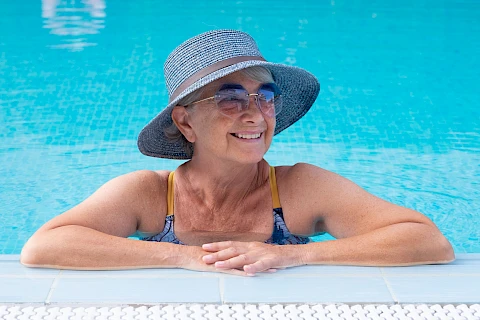
Spending a June afternoon on the porch in Sewickley or taking a walk through Crafton's parks sounds exactly right this time of year. But skin changes significantly with age, and what felt fine at 45 can lead to real damage at 75. For caregivers, sun protection for seniors deserves attention every day, not only on beach days or summer outings.
Why Older Skin Needs More Protection
Aging skin is thinner and produces less melanin, the pigment that offers some natural defense against UV radiation. It also repairs itself more slowly, meaning sun damage accumulates faster and heals less completely. Seniors who take certain medications, including some blood pressure drugs, diuretics, and antibiotics, may be even more photosensitive than usual. If your loved one in Dormont or Ben Avon is on a new medication, it's worth asking the prescribing physician whether sun sensitivity is a side effect.
The American Academy of Dermatology recommends a broad-spectrum sunscreen with SPF 30 or higher for daily use. Apply it to all exposed skin about 15 minutes before going outside. Reapplication every 2 hours matters, especially if your loved one is perspiring or has been near water.
Choosing and Ensuring Compliance With Sun Protection Products
Many older adults resist sunscreen because they dislike the texture, the smell, or the application step. These are real objections worth working around rather than ignoring. Lightweight, fragrance-free lotions are often more tolerable than heavy creams. Stick formulas work well for face and hand application without the mess. Some seniors find it easier to use a spray formulation on arms and legs, though it still needs to be rubbed in for full coverage.
Make sunscreen part of a morning routine rather than a separate task. Kept on the bathroom counter next to a daily moisturizer or near the door where shoes and hats live, it's easier to remember. If your loved one tends to forget or resist, a caregiver can help by simply handing it over at the right moment with a light touch.
Protective Clothing and Timing
Fabric is often more effective than sunscreen for consistent protection. Long sleeves in lightweight, breathable materials, wide-brimmed hats, and UV-blocking sunglasses make a meaningful difference. Tightly woven fabrics block more UV than loosely woven ones. Sun-protective clothing lines are designed for comfort in warmer weather.
Timing matters too. In Pittsburgh-area communities like Moon, McKees Rocks, and Emsworth, summer afternoons between 10 a.m. and 4 p.m. carry the highest UV index. Morning and early-evening outings offer the same fresh air and movement with considerably less UV exposure. On days when outdoor time is unavoidable at peak hours, shaded areas, a tree-lined street, or a covered porch make a significant difference.
Monitoring for Changes
Caregivers who help with bathing or personal care are well-positioned to notice new or changing spots on the skin. The ABCDE rule (Asymmetry, Border irregularity, Color variation, Diameter over 6mm, Evolution over time) provides a useful framework. Any suspicious spot deserves a dermatologist's attention sooner rather than later.
Every Day Sun Protection for Seniors in the Pittsburgh Area
Protecting older skin from sun damage is a year-round effort. Caregivers in Avalon, Bellevue, Ben Avon, Carnegie, and Coraopolis don't have to navigate it alone. Senior Helpers of Northwest Pittsburgh provides consistent, attentive in-home care that keeps your loved one safe and well every day of the year. Contact us to learn how our caregivers can help.